Sunday, 4 March 2012

Large Black Weaners for Sale...

We have Pedigree Large Black Weaners for Sale. Birth Registered with the BPA...


Born and raised on our School Farm they are very friendly, calm and delightful pigs, not to mention the rarest pigs in Britain!

Thursday, 1 March 2012

How to build a cold smoker...

A cold smoker is used to flavour and preserve meats, fish and cheese. The products aren't cooked in the smoking process but instead gain flavour from the wood chips being used to generate smoke...

You will need:

1 x Small Garden incinerator
1 x Angle grinder with cutting blade
1 x 3m Length of Flexible Aluminium Duct (We have used 100mm diameter)
1 x Wardrobe (one equipped with a draw at the bottom will make life easier)
1 x Jigsaw
1 x Drill Equipped with a 10mm wood bit and a 24mm wood bit
1 x Tape measure
1 x Mitre

The first step is to create a fire chamber for the fuel.

1. You need to create a fire chamber. The hose that joins the fire chamber to the smoke box needs to have the same diameter as the exhast exit of your fire chamber so don't order your duct until your fire chamber is complete. For your fire Camber you can use all sorts of devices from garden incinerators to old fridges and even old and very empty Calor gas cannisters. You can also buy ready made smoke generators. If you use a gas canister ensure that all the gas has been removed by filling it with water and allowing the gas to dissolve before being emptied.
Fire chamber made from old calor canister

2. Your fire chamber needs a small entry for air, and an exit for smoke. It is an advantage if you can cover or close off the air hole in order to generate the smoke.

The smoke house design is very straightforward just remember that it needs to be built so that it is higher than the top of the fire chamber as warm air rises. this is importnat as you will need to build a stand for your wardrobe and the bigger you fire chamber the taller your stand.

3. Remove the draw from the bottom of the wardrobe and the back of the wardrobe to provide access. It may also be useful to remove the doors Remove the draw front from the rest of the draw and screw it back into the front of the wardrobe. The draw should look as if it can be opened.
The view from the back showing the draw front in place and smoke holes above

4. Manufacture a new base to the wardrobe and attach it to the bottom of the wardrobe  using batons. This will mean that once the back is inplace, the base should become a sealed unit.

5. If at this point you know the diameter of your aluminium pipe then cut an access into one side of the newly created chamber so smoke can enter.

6. At the top of the newly created chamber using the 10mm drill bit, drill a series of holes in a grid fashion. this will allow the smoke to percolate from the bottom smoke chamber into the main body of the wardrobe where your meat and fish will hang.
The grid of holes will aloow the smoke to percolate through the smoke house

7. At the top of the wardrobe, at either side use the 24mm drill bit to drill three holes to allow the smoke to exit from the wardrobe.
Exit holes

8. Use bathroom sealant to fill any gaps around the bottom smoke chamber so it is relatively air tight.

9. Rehang the doors and replace the back of the wardrobe.

10. Link your fire chamber to your wardrobe (Smoke house) with the aluminium pipe. Allow the pipe to dip slightly in the middle as it will collect condensation

The finished smoker. At the bottom right of the wardrobe you can see the entry point for the cold smoke. The wardrobe is lifetd on a plinth the smoker would usually sit on the floor at the side linked with the aluminium ducting. 

Thursday, 23 February 2012

The joys of Lambing


We have been very lucky this year as we have had several triplets born, unfortunately sheep aren't designed to raise more than two lambs at a time as they only have two functioning teets, this means that sometimes we need to help our ewes out with a little bit of bottle feeding. Not that it's too much trouble for our students...

Wednesday, 22 February 2012

Signs of Spring...

Spring must be here as the bleating of newborn lambs fills the air around the farm...

The Ewe's have a nice warm barn in which to give birth


The ewe's are left to bond with their lambs, in case they are seperated they are clearly marked so we can reintroduce them.
During labour the ewe's have the safety and securtity of the barn but during the day they are free to graze in the open air
One of our newest arrivals, as soon as he's strong enough he'll be out and frolicking in the fields

Cosying up in the creche

Sunday, 19 February 2012

Saddleback Weaners for Sale...

 
These are a small selection of our pedigree stock for sale. If you are interested contact us at 01525 404462

Saturday, 11 February 2012

How to Butcher a Pig...

Traditionally we have always receieved our pigs ready butchered courtesy of Helletts and Son from Kimbolton. This weekend however, we decided to have a go ourselves. At the end of the day how hard can it be? Well here is a guide of how to butcher a pig:

You will need:
A bone saw, a set of butchers boning knifes and a good quality butchers steak knife. Also of some use would be a meat cleaver and a steady hand!!!


1. Start by removing the head. Use a good quality butchers knife to slice about three fingers from the back of the ear down towards the spine until you meet bone. Roll the half over and repeat until your cut meets the bone. Use a bone saw to cut through the bone.


2. You now need to seperate the hind leg or hams. The pelvic bone should be partially visible from where the pig has been split. Use this as a guide to separate the leg at right angles to the line of the spine (A row of bones running along the back of the pig often knwon as the chine bones).


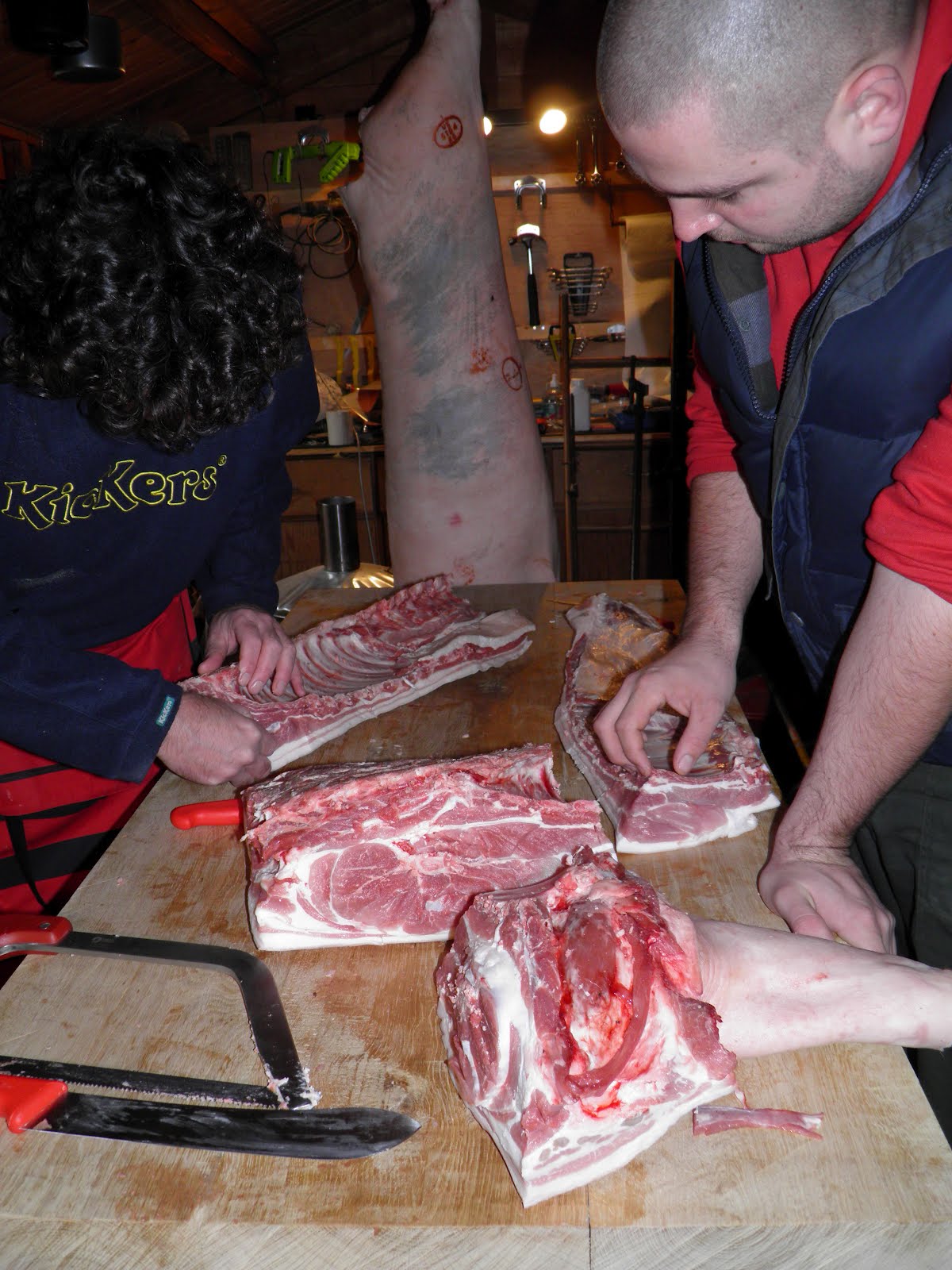
3. Next remove the belly from the loin. At the rear of this section (The section formally attached to the ham) Their is a clear demarcation between the scrag end of meet and the lighter leaner eye of the chump end. Using this as start point use a knife to run along the full length of the pig from this point half way up the ribs and all the way along under the chine bones. Use a sharp boning knife to start your cut following the line until you meet the rib. Switch to the saw and using your hand to support the pig underneath saw through the ribs. Finish this cut with the knife and you should be left with two clear sections as in the picture. In the fore ground you can see the two sections of the shoulder and front leg (Picnic ham). The two sections being handled are the loin with spare rib on left (tenderloin already removed) and belly with short rib on the right.

4.  Next you need to remove the tenderloin, it sits in the top section of the middle of the pig (The loin section) at the chump end. Using the chine bones as a guide follow their natural line to gently slice this cut from the rib and chine.

5. Now you can seperate the front leg and shoulder. A good rule of thumb is to use the ribs as a guide when seperating this section. Count four ribs along from the front of the and push a boning knife all the way through to mark the line of cut. Use a steak knife to start your long cut at right angles to the chine. When the knife hits the chine switch to the bone saw to seperate out the joint. This joint can now be cut in half at the elbow joint leaving you with the shoulder joint and the picnic ham .

6. You are now left with some decisions to make. It is best to seperate the belly section into two halves by slicing neatly just before the ribs.

7. The loin section is best split into three, The chump (The section of the loin containing only chine bones but no ribs) is split from the loin and makes a lovely stuffed and rolled joint. This just leaves the loin joint with spare ribs attached. These are easily removed by using the ribs to gently guide the cut of the knife.
Splitting the Ribs from the loin
The spare rib and remaining loin joint, each best split into two halves


You are now left with several very large joints and several much smaller ones. The larger joints can be literally cut in half with liberal use of knife and saw. All told half a pig will yield a thoroughly good amount of tasty meat.
Joints boned and rolled ready for roasting

Vacuum packed ready for the freezer all told 8 family roasting joints and many other interesting cuts from just 1/2 a pig
All the major joints before cutting into smaller more mangeable pieces

One half down, one half left...